
Posts tagged evil

memory part 1: 65 years ago

So. This is about amnesia.

Or lack of long term memory.

Look.

We Americans certainly have a pattern of historical amnesia on occasion.

And the day I am going to refer to edges upon an amnesia moment.

VJ Day.

Huh?

Known most for this picture to the right.

VJ Day  is the day that Japan officially surrendered to the US and ended World War 2.

Of course everyone has seen the picture but if you think about it (beyond the obvious joy of two people – regardless of whether it was staged or not) it is a peek into a world none of my generation knows.

A world that believed total victory was possible. A world that said large sacrifices needed to be made to gain large things (democracy, freedom … stuff like that). A world that said you made hard decisions that often in retrospect may look not as black & white as you would like but in the moment achieved what needed to be achieved.

The Cold War (a 50 year silent war) was on the horizon.

This is a world difficult for any of my age group or younger can fathom.

It was on August 14th in 1945 that Americans were greeted with a two-word newsflash, “Japan Surrenders” World War II was over.

(note: it was August 15th in Japan, but, because of time zone differences, it was August 14th in the US.)

Most of us greeted the VJ Saturday as a day away from the office. Just a weekend day that gave us an opportunity to spend time with family, to shop or just relax.

It should have been a big day for remembrance.

August 14th marked the end of a conflict that claimed more human lives than any in history.

Many people believe that WWII ended with the dropping of the two A-Bombs on Hiroshima on August 6th and Nagasaki on August 9th but the Japanese did not immediately surrender after these attacks. In fact, there were Japanese rebels who wished to prolong the war

All Americans should take time to remember days like V-J Day and remember the men and women who fought to preserve the precious freedoms we almost lost.

War brought America together. Our military and citizens performed heroically, sacrificing on the home front as well as in combat. Political and personal disagreements were set aside. Output from our factories soared as the country became the arsenal of democracy in this global conflict. Americans united and labored as one, working toward a single goal: victory against the forces of totalitarianism and racist ideologies.

Victory would come, but it was hard won. On May 8, 1945, Germany capitulated. Then, following the atomic bombs dropped on the Japanese cities of Hiroshima and Nagasaki, Japan surrendered on august 14th.

There is urgency to addressing our historical amnesia. WWII veterans are dying at the rate of 800 a day, according to statistics from the U.S. Department of Veterans Affairs. This year there are 1,981,216 surviving veterans in the USA. In 2020 there will only be 269,721. Those who experienced V-J Day are leaving us.

Nowadays, it seems VJ Day celebrations are muted mostly because as we look in retrospect we tie the end of the war with the Air Force B29s, Enola Gay and Bockscar, dropping Little Boy and Fat Man, the atomic bombs on the essentially civilian targets of Hiroshima and Nagasaki. The bombs killing over 200,000 people, including many women and children.

My opinion?
Muted celebrations.

What’s done is done and don’t think for a moment that the Japanese wouldn’t have dropped a couple on the Allies (Americans and/or America) if they had them.

War is an ugly. And WW2 was all that. But one cannot suggest that the Allies should have sacrificed hundreds of thousands, if not millions, of their own troops in an invasion of Japan in order to spare Hiroshima and Nagasaki.

But. War is about winning (within a morality structure) with the least expenditure of your own soldiers and people. Period.

Oh. I would also like to point out, even without an atomic bomb, the Japanese managed to kill more innocent Chinese civilians at Nanking alone than the two atomic bombs together.

Historical amnesia.

Now. Historical amnesia is a scary thing. Because in generations and cycles and recurring actions (recurring mistakes) and memories it means we forget. And if we forget it means we are more likely to do again. Sound silly when you talk about something like a war the size of World War 2? Hmmmmmmmmmmmmm … not really.

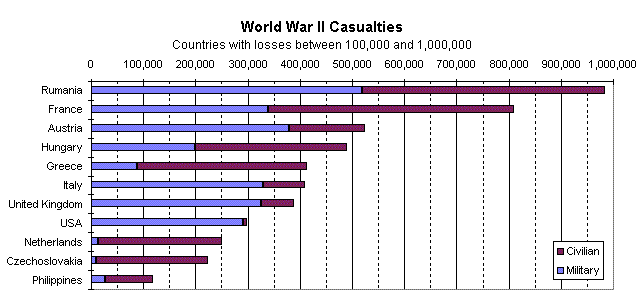
At the end I have some casualty graphs.

I sometimes believe World War 2 is becoming just a phrase.

As time goes by the true extent of that conflict (versus say a 9/11 which admittedly did happen on our home land which WW2 did not) is stunning in comparison. It may not be fair to compare 3000 to 1 million but numbers are numbers are numbers.

And if we do not remind ourselves of things like this on occasion we are doomed to make similar mistakes in the future and allow it to happen all over again.

Why? Because, of course, it could never happen to us (or so we say to ourselves).

Anyway.

Thus, while we may be a forward-looking people, I encourage all Americans to pause and reflect on the sacrifice of the Hero generation. The GI generation.

Remember V-J Day. Remember all remembrance days of World War 2 and the Korean War.

Seek out a GI veteran (heck. any veteran actually) and thank him or her.

They really did change the world.

To end this.

Some historical numbers to remember. Many many people took part in World War 2 and sacrificed a lot for us to be living the lives we lead today.

And we shouldn’t forget what they did … for us.

If you want to keep a secret call the Red Cross

I love learning new things and I just did (ok. maybe back in December but I just thought about writing something because I just wrote about the dilemma of Conscience and the price of Evil).

I have always known that the Red Cross is staunchly neutral. Meaning that they will be silent in the face of any inhumanity or evil in order to meet the on the ground obligations of dealing with the human needs. They do this within conflict (war work well known) as well as humanitarian efforts for disaster relief – disaster being both natural and manmade. I didn’t know this but they have a network of humanitarian volunteers in over 186 countries.

Despite some pressure from other aid organizations the Red Cross staunchly defends its impartiality to politics and “evil doings” as being the advantage to serving the needs of the people anywhere.

Because of their stance in countries ravaged by war and genocide, the local Red Cross efforts have proven quite resilient. Basically, Red Cross (or Red Crescent societies – latter title preferred in many Muslim countries) gains access to areas others cannot in order to help those in need … because they are fanatically secretive with regard to what they see and hear around them.

The needs of those who are in harm’s way stand far above anything else they may feel.

I have one word for this – wow.

Ok. Let me share an example of why I say “wow.” (and I could use many but this ties into my Conscience post)

For example. In World War II the Red Cross could have possibly been invited to assist in aiding Concentration Camp victims but would have been required to tell no one about the Concentration Camps. Wow.

(this is only partially hypothetical because I believe they did work with Nazis in some situations)

If you want a moral dilemma take this one on. But I do know one thing. While I am fairly sure I couldn’t do it I am glad someone can…and someone does. I admire the Red Cross as an organization relentlessly sticking to its vision and mission and understanding their end objective – assisting people in need. They understand they cannot control Conflict but rather only serve those in the aftermath of conflict.

I cannot imagine how difficult it is to maintain their discreet silence in the face of terrible atrocities.

This is simply a “wow” post from me. I guess I never really knew, or maybe took the time to think about, the extent of their “silence to do good work” manifesto.

Wrapping my head around this makes my head hurt. Thank god for an organization like the Red Cross and the minds who created it with the vision they maintain today.

The Complexities of Conscience: Knowing what to do

So. I had lunch with a high school friend I hadn’t seen for over 25 years (and it was a lot of fun) and she mentioned one of the guys in our high school had produced the documentary “Darfur Now.”

It is a documentary about the atrocities in Darfur, the westernmost region of Sudan. It poses a fundamental question: How do you respond to an event such as a government-sponsored mass murder of part of a country’s civilian population?

The United Nations has estimated that by 2007, 200,000 people had been killed and 2.5 million displaced in Darfur.

The truly heartbreaking documentary takeaway is that “You see that kids really are just kids.” And there is an overwhelming sense of hopelessness.

In the movie, the official voice of the Sudanese government belongs to Abdalmahmood Abdalhaleem Mohamad, Sudan’s ambassador to the United Nations, who scoffs at the notion of a genocidal campaign against the people of Darfur. The conflict is an internal matter, he insists, and has to do with the apportioning of scarce resources.

Sudan has refused to comply with the International Criminal Court’s recent arrest warrants for Ahmad Harun, Sudan’s minister of the interior, and Ali Kushayb, a leader of the Janjaweed militias, for crimes against humanity.

I guess I share all of this because in my own little world this is an unacceptable action against humanity.

But I honestly don’t know what to do about it.

Does America send troops?

Does America shirk responsibility and pass it along to UN?

Is it even our role to take care of this?

I wrestle with this. And I could argue both sides. In the end I land on, if we don’t do it who will? Sort of like if I see a crime happening across the street (like a child being beaten by thugs) and I have the power to do something and I don’t, am I not complicit to the crime?

Maybe more importantly to me as a person as I think about this:

How would I be able to go to sleep that night if I did nothing?

Darfur is a horrendous example of what is happening outside our borders but it makes you start thinking. Like. You wonder if things like the holocaust wouldn’t have happened if more people had stood up and done the right thing. In the end I guess we also have to wonder what we would have done in that situation. It is difficult when you talk about theoretical life versus real life. Unfortunately, Darfur is real life. The here and now.

Anyway. It is sometimes easy to ignore these types of things happening outside our borders.

Out of sight out of mind

It is very easy even in the age of YouTube and cellular images to just not see what is happening elsewhere.

Because we have our own problems.

Recession. (And all the stuff that comes with it).

Our soldiers dying in Afghanistan (and do we want to send more somewhere else)

Maybe worse is ignorance. Where is Darfur? Does it really matter? And, of course, our overall perceptions of undeveloped African countries.

If we haven’t been there it is often easy to think of some of these places like horse and buggy countries. Absolutely some of these places have rural areas with spotty technology and living support (we forget how large some of these places are geographically because maps kind of lie with regard to size and stuff).

So. In the end I have no answers just questions. However. I do have a suggestion even more important than watching Darfur Now. A way to give yourself real perspective.

How can you gain perspective? Oh. It’s easy. Evil shows its price tag. Read the rest of this entry »