
Posts tagged liberty and fraternity

memory part 1: 65 years ago

So. This is about amnesia.

Or lack of long term memory.

Look.

We Americans certainly have a pattern of historical amnesia on occasion.

And the day I am going to refer to edges upon an amnesia moment.

VJ Day.

Huh?

Known most for this picture to the right.

VJ Day  is the day that Japan officially surrendered to the US and ended World War 2.

Of course everyone has seen the picture but if you think about it (beyond the obvious joy of two people – regardless of whether it was staged or not) it is a peek into a world none of my generation knows.

A world that believed total victory was possible. A world that said large sacrifices needed to be made to gain large things (democracy, freedom … stuff like that). A world that said you made hard decisions that often in retrospect may look not as black & white as you would like but in the moment achieved what needed to be achieved.

The Cold War (a 50 year silent war) was on the horizon.

This is a world difficult for any of my age group or younger can fathom.

It was on August 14th in 1945 that Americans were greeted with a two-word newsflash, “Japan Surrenders” World War II was over.

(note: it was August 15th in Japan, but, because of time zone differences, it was August 14th in the US.)

Most of us greeted the VJ Saturday as a day away from the office. Just a weekend day that gave us an opportunity to spend time with family, to shop or just relax.

It should have been a big day for remembrance.

August 14th marked the end of a conflict that claimed more human lives than any in history.

Many people believe that WWII ended with the dropping of the two A-Bombs on Hiroshima on August 6th and Nagasaki on August 9th but the Japanese did not immediately surrender after these attacks. In fact, there were Japanese rebels who wished to prolong the war

All Americans should take time to remember days like V-J Day and remember the men and women who fought to preserve the precious freedoms we almost lost.

War brought America together. Our military and citizens performed heroically, sacrificing on the home front as well as in combat. Political and personal disagreements were set aside. Output from our factories soared as the country became the arsenal of democracy in this global conflict. Americans united and labored as one, working toward a single goal: victory against the forces of totalitarianism and racist ideologies.

Victory would come, but it was hard won. On May 8, 1945, Germany capitulated. Then, following the atomic bombs dropped on the Japanese cities of Hiroshima and Nagasaki, Japan surrendered on august 14th.

There is urgency to addressing our historical amnesia. WWII veterans are dying at the rate of 800 a day, according to statistics from the U.S. Department of Veterans Affairs. This year there are 1,981,216 surviving veterans in the USA. In 2020 there will only be 269,721. Those who experienced V-J Day are leaving us.

Nowadays, it seems VJ Day celebrations are muted mostly because as we look in retrospect we tie the end of the war with the Air Force B29s, Enola Gay and Bockscar, dropping Little Boy and Fat Man, the atomic bombs on the essentially civilian targets of Hiroshima and Nagasaki. The bombs killing over 200,000 people, including many women and children.

My opinion?
Muted celebrations.

What’s done is done and don’t think for a moment that the Japanese wouldn’t have dropped a couple on the Allies (Americans and/or America) if they had them.

War is an ugly. And WW2 was all that. But one cannot suggest that the Allies should have sacrificed hundreds of thousands, if not millions, of their own troops in an invasion of Japan in order to spare Hiroshima and Nagasaki.

But. War is about winning (within a morality structure) with the least expenditure of your own soldiers and people. Period.

Oh. I would also like to point out, even without an atomic bomb, the Japanese managed to kill more innocent Chinese civilians at Nanking alone than the two atomic bombs together.

Historical amnesia.

Now. Historical amnesia is a scary thing. Because in generations and cycles and recurring actions (recurring mistakes) and memories it means we forget. And if we forget it means we are more likely to do again. Sound silly when you talk about something like a war the size of World War 2? Hmmmmmmmmmmmmm … not really.

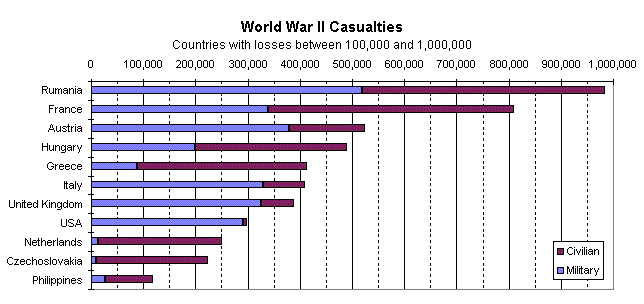
At the end I have some casualty graphs.

I sometimes believe World War 2 is becoming just a phrase.

As time goes by the true extent of that conflict (versus say a 9/11 which admittedly did happen on our home land which WW2 did not) is stunning in comparison. It may not be fair to compare 3000 to 1 million but numbers are numbers are numbers.

And if we do not remind ourselves of things like this on occasion we are doomed to make similar mistakes in the future and allow it to happen all over again.

Why? Because, of course, it could never happen to us (or so we say to ourselves).

Anyway.

Thus, while we may be a forward-looking people, I encourage all Americans to pause and reflect on the sacrifice of the Hero generation. The GI generation.

Remember V-J Day. Remember all remembrance days of World War 2 and the Korean War.

Seek out a GI veteran (heck. any veteran actually) and thank him or her.

They really did change the world.

To end this.

Some historical numbers to remember. Many many people took part in World War 2 and sacrificed a lot for us to be living the lives we lead today.

And we shouldn’t forget what they did … for us.

Célébrons ! bastille day, baguettes & vel’ d’Hiv


Bastille Day

So. Today, July 14th, France celebrates its national holiday in commemoration of the storming of the Bastille prison. Oh. Everyone should also note that if you want anything done in France today forget it. I flew through De Gaulle airport one 14th only to find out about 50% of the workers didn’t show up that day. Needless to say there were some delays.

Anyway. Bastille Day commemorates the storming of the Bastille, which took place on 14 July 1789 and marked the beginning of the French Revolution marked the end of absolute monarchy, the birth of the sovereign Nation, and, eventually, the creation of the (First) Republic, in 1792.

The Bastille was a prison and a symbol of the absolute and arbitrary power of Louis the 16th’s reign. By capturing this symbol of the king’s power, the people signaled that the king’s power was no longer absolute.  The people began a new government with power based on the nation and limited by a separation of powers.

Although the Bastille only held seven prisoners at the time of its capture, the storming of the prison was a symbol of liberty and the fight against oppression for all French citizens. The other symbol remains the French Tricolore flag. It symbolizes the Republic’s three ideals: Liberty, Equality, and Fraternity for all French citizens.
What English speakers call Bastille Day the French call le 14 juillet. If you want to wish French speaker a happy Bastille Day “Bonne Bastille !” is the simplest. But say Joyeux Quatorze Juillet ! and a Frenchman will smile.

“Une baguette de tradition, s’il vous plaît.”

Nothing beats a Parisian baguette which you can pick up at almost every corner in Paris as you walk. Oh. The “de tradition” part is important, because a traditional baguette tastes a whole lot better than a regular baguette. It’s usually slightly more expensive but worth it (a good baguette only costs around €1.20).

So. Ever wonder why the streets of Paris almost smell so nice (the fresh smell of bread and baking). An authentic baguette has a shelf life of only four hours so bakeries churn out fresh loaves throughout the day.

Oh, some other baguette protocols. If there’s a line, as there is at almost every boulangerie with excellent baguettes better have exact change ready (no fumbling at the counter or you can quickly uncover the surliness of the French).  And say “Bonjour Madame/Monsieur” when it’s your turn, ask for your baguette (hesitating makes them move on to the next person in line) and put down the exact change when you get your baguette. With it, you are likely to hear the French word “Parfait!” and get a smile.

rue de Saintonge and Marais district and Vel’ d’Hiv

Famous for its 17th-century mansions, its Jewish heritage, a vibrant contemporary gay scene and edgy art galleries, the Marais district is also filled with quirky, unique boutiques specializing in the coolest fashion, the hottest design and the trendiest beauty products. The Marais is the labyrinth of streets stretching south from Boulevard du Temple in the 3rd arrondissement stretching into the 4th arrondissement. The Marais is interesting, sometimes not for the faint of heart and unlike walking the more touristy areas this Paris district is chockfull of a vivid mix of characters. Stroll its medieval lanes and you’ll rub shoulders with muscle-shirted gays and feather-boa transvestites and long-bearded rabbis and scruffy rock musicians and West African restaurateurs and Eastern European bakers.

Rue de Saintonge is in the 4th arrondissement near the center of the Marais (I think). This is one of my favorite neighborhoods as it is lively, eclectic and contains several of the oldest sections of the city as well as lots of trendy bars, shops, and restaurants. The rue des Rosiers is a centerpiece of Jewish lifestyle in Paris and the Ile St. Louis and the Ile de la Cité are the oldest parts of Paris.

A moment about rue de Saintonge

What makes this even more interesting is that I just finished reading a book called Sarah’s Key which centers its historical fiction story around an apartment on rue de Saintonge. The book’s back story revolves around a relatively unknown event during WW2 in occupied France involved with the Holocaust. An event, Vel’ d’Hiv, whose anniversary is on July 16th.

Vel’ d’Hiv (commonly called the Rafle du Vel’ d’Hiv – “Vel’ d’Hiv Police Roundup” – from the nickname for the  Velodrome d’Hiver -”Winter Velodrome” cycle track) was a Nazi decreed raid in Paris on July 16 and 17, 1942, code named Operation Spring Breeze (Opération Vent printanier).

The roundup was one of several aimed at reducing the Jewish population in Occupied France. According to records 13,152 victims were arrested and held at the Vélodrome d’Hiver and the Drancy internment camp nearby, then shipped by rail to Auschwitz (of which almost 100% perished. The roundup, which was part of a continentwide plan to intern and kill Europe’s Jewish population, was a joint operation between the Germans and French leaders. The Vel’ d’Hiv roundup wasn’t the first. Nearly 4,000 Jewish men were arrested on 10 May 1941 and taken to Gare d’Austerlitz and then to internment camps and then to the “death” camps. Women and families followed in July 1942.

Roundups were conducted throughout France but public outrage was greatest in Paris because of the numbers involved in a concentrated area. The Roman Catholic church, which had not always been quick to condemn the Germans, even spoke out in protest. Public reaction obliged French leadership in occupied France to ask the Germans on 2 September not to demand more Jews.

The roundup accounted for more than a quarter of the 42,000 Jews sent from France to Auschwitz in 1942, of whom only 811 came home at the end of the war. I believe French Jews represented about 80,000 of the total 6 million Jewish people who died during the Holocaust.

Do I say this to diminish this event?

Nope.

I mention it to remind people that if you solely focus on 6 million you forget the smaller horrible events that took place in every country occupied by the Nazis during World War 2 that contributed to an incomprehensible number.

Everyone was accountable for the Holocaust. And it is very easy for us to suggest all those who did nothing to stop it should be shamed (and I believe all do feel it) but unless you were there, unless you know what it is like to be under the thumb of ferocious dictatorship it is simpler to just say “we were all accountable and a brave few knew how to have the courage to stand up.”

And while it may be easy to also focus on the complicity of the French police and government in this event (as well as any government in occupied Germany during this time) I will note to complete this particular section that 3,158 persons were awarded the Righteous among the Nations honor (of which 160 received a Legion of Honor).

-          note: Righteous among the Nations (Chassidey Umot HaOlam, more literally: righteous men of the world’s nations, also translated as “Righteous Gentiles”) is an honorific used by the State of Israel to describe non-Jews who risked their lives during the Holocaust to save Jews from extermination by the Nazis.

The French, as do many countries, refer to the days of WW2 occupation and the holocaust as “their darkest hour.”

So.

On Bastille Day I would ask that they remember the few (of probably many) who were recognized for standing up to evil.

And on the 16th they remember that evil is difficult to face.

Célébrons ! Bastille Day.