

====
“Modeling the world as it is, is one thing. But as soon as you being using that model, you are changing the world, in ways large and small. There is a broad assumption underlying many machine-learning models that the model itself will not change the reality its modeling. In almost all cases, this is false.”
Brian Christian
====
“The proper method for hastening the decay of error, is not, by brute force, or by regulation which is one of the classes of force, to endeavor to reduce men to intellectual uniformity; but on the contrary, by teaching every man to think for himself.”
William Godwin
====

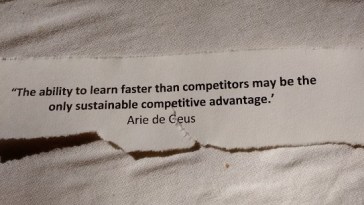
Back in the 1970’s (maybe 80’s) Arie de Geus suggested “the ability to learn faster than competitors may be the only sustainable competitive advantage” and the idea of a business in perpetual motion was solidified. Well. That is assuming you were paying attention to Arie and agreed with him.
Business has, since then, gussied up constant learning with scale, velocity, and a variety of other nifty terms to communicate ‘business being in perpetual motion.’ At the core of all of this is that systems (business) are internal models of their environment which progressively and iteratively improve as systems accumulate knowledge and experience. In other words, systems learn. I share that because effective motion is a derivative of understanding systems and people and decision-making.
Which leads me to Motion (in general).
To do lists are endless with lots checked-off but never get shorter. People are working long hours but what is done never seems to create any meaningful progress. This is motion while being stagnant. It’s like a hamster in a wheel. It’s not only unsatisfying for the people in the wheel, but the business itself doesn’t gain any satisfying results (although managers are usually quite creative in result presentations to make it seem like shit is moving everyone forward).
What I am suggesting is motion is always about decisions. What I mean by that is there is never any lacks of things to do in a business but some just aren’t worth doing.
Meaningful motion projects fall into 2 slots:
- value creation initiatives which increase motion of value offered
- motion initiatives which increase the motion of the organization itself & indirectly enhances value
Choose your projects wisely. Meaningful motion is all that matters. That said. Motion will always inherently contain some ambiguity. What I mean by that is even with the existence of the best information available <and learning> it will be simultaneously true that (a) people will not agree what that information says and (b) people will not agree what the future will bring. This means goal commitment may be necessary, but not sufficient in accomplishing goals.
“Don’t confuse a flurry of activity for progress. That’s a magician’s trick.”
One of my past Bosses
What do I mean?
How often do we see a company doing lots and lots of shit yet we don’t really see any progress? That’s a business in love with motion in and of itself. That’s a business which justifies return off of doing and not progress. In the end. Motion has a direct relationship to ‘doing shit’ (progress type projects, not speed or stagnant projects) and “doing shit with utility”.
Which leads me to decision utility.
Motion, at its core, is about decision utility, i.e., which decision will create the greatest return. I call it Return on Choice (ROC). In business you face a relentless onslaught of decisions to be made. Success is often dictated by how well you choose what is important versus what is not as important versus what is not important at all.
Let’s face it. No matter how good you are you will not always get this right.
Let’s face it. We could all become more adept at making choices because, let’s face it, if anything, we seem to have become worse at making thoughtful choices.
I would be remiss if I didn’t point out there is a direct relationship between ROC and impatience, i.e., too impatient poorer ROC and just enough patience higher ROC.
Now. I am all for, and a huge proponent of not dicking around <the technical term for ‘wasting time overthinking’> when a choice needs to be made. But there is a difference between making speedy decisions and making a decision because speed is the main criteria. The latter encourages impatient decision making which lessens decision utility.
This happens for two reasons:
- Impatience exacerbates our typically poor prioritization skills
- Impatience emphasizes Personal bias
That said.
A key part of decision utility and motion is prioritization skills
Since we live in a world of infinite possibilities, it’s so hard to figure out what to do, when, and where.
If you start thinking this way … well … you begin living in a world strewn with hypotheticals.
If I do A, then this will happen. But what if I do B? Will it be better? Will I get back more? Will everyone around me be more satisfied? Or what about C? That looks good. Oh. But someone suggested D.
You get it. There are 26 letters in the alphabet and while most of us stop way before Z, even getting to D can be maddening. It seems like the world is your oyster, everything is possible, but you don’t take advantage of any opportunities because you’re not sure of what’s best.
This is where I remind everyone what US President Dwight D. Eisenhower supposedly said: ‘The most urgent decisions are rarely the most important ones’. Misreading the urgent from the non-urgent and the important from the unimportant may create impatience at the wrong time and waste energy & focus. Smart business patience, and motion, at its simplest is grounded in the The Eisenhower Matrix. While Stephen Covey is often credited with the decision-making matrix it was actually Dwight Eisenhower, considered a master of time management, who developed the matrix.

Yeah. Decision utility is often driven by effective prioritization, i.e., what to do and what not to do.
“Mental clarity ain’t for the faint of heart.”
Katerina Stoykova Klemer
Which leads me to the battle between Motion and Personal bias.
Decision utility has to navigate the ‘personal bias’ maze.
“Being aware of our own biases doesn’t mean we aren’t still susceptible to them.”
Faris Yakob
When impatient we get, well, lazy. We lean in on our bias which is unfortunate because thinking takes hard work and every choice has opportunity costs. Unfortunately, most of us are not good at assessing ROC <return on choice> when viewing things thru a bias.
People need to invest in working to eliminate bias.
Invest in developing the choices <and however many we need to feel like we have enough to assess assuming that is a finite number>.
Invest in actually assessing the choices <better, betterest & best assuming a best can be actually identified>.
Invest in the actual choice.
Invest in learning so the choices make more and more sense.
 I imagine we are talking about the proper investment in time because organizational impatience leads to the permitting of poor choices <and a quicker death of a thousand cuts>.
Let me be clear. Dealing with impatience and balancing impatience & patience ain’t for the faint of heart. Managing decisions is all about a thorough understanding of the decision’s hierarchy of needs, navigating bias & understanding the attributes in a span of time that generates the most rewarding outcome. Being impatient doesn’t mean you ignore this thinking but rather you incorporate it into your impatience <and it can dictate how patient you are in your impatience>.
Successful impatient decision making is about having, well, a rigid policy of flexibility.
Ok.
Translation. Effective impatient patience is all about mental clarity. Creating mental space to see things, feel things, absorb things and make those things into a decision or choice <that is learning by the way>.
Which leads me back to decision utility.
When you are facing a choice, making that decision <yes or no, do it or don’t do it>, you go through a cost-benefit check that may last anywhere from a split second to days, weeks, or even months <and yes even months can be an impatient patient choice>.
Such choices come up many times a day and time is a factor in virtually all of them.
It is easy to see how impatience can be abused if we regard life in today’s world as an almost unbroken fast-moving river of choices/decisions. In that world, utility becomes blurry and learning is a luxury.
Anyway. It is easy to see how with everything moving so fast all the time you can actually feel like you are speeding along even without making any good ROC choices. But 99 times out of a 100 there is little meaningful motion, just motion. I imagine my large point is that to ensure learning is useful and sustainable, you should probably iterate (OODA-ize) your motion. OODA makes tangible decision utility and learning value.
Which leads me to reductionism (which, OODA, used poorly, can lead to).
Reductionism never works because, well, it kills motion. Ok. It reduces larger motion of the whole system. It ‘right sizes’  motion under rationalizing energy use and thereby not only restricts expansiveness of motion but also the expansiveness offered by the larger system.
That said, to protect the ‘effective doers’ a bit, deliverers of effective consistency <let’s call us ‘the everyday working schmucks’> are kind of screwed in today’s business world in that you can clearly have focus and your consistency may be less clear to those around you.
If I have two major gripes in today’s business world, it is that we, leaders & managers, need to:
– Better recognize the unseen portions of consistency <the focus within the inconsistency>
– Better accept the unseen portions of consistency <the focus within the inconsistency>
Inconsistency and consistency <embracing both> is a skill & an art. I would note embracing some inconsistency and yet maintaining some consistency is kind of the key to successful perpetual motion in business.
Which leads me to motion in a complex, dynamic, environment.
 Learning should seek to harness aspects of the system and complexity to enable perpetual motion. Yeah. Complexity is not an issue. The world is complex, an industry is complex, a business is complex, people are complex, heck, even learning is complex. We deal with complexity every day. To enable motion, we need to ‘de-confuse’ complexity. this does not mean dumbing it down or stripping it of important detail, it means making it understandable . The more things are understandable, the simpler they appear. When things appear simple, they become useful. On the other hand. Too simple is not useful. In addition, contrary to popular belief, complexity is actually interesting and people engage in complex environments BECAUSE they are dynamic. It has an inherent feel of motion (versus stagnancy) which people find appealing. Now. Too much ‘motion’ (or too fast), or being confused, kills the appeal. Therein lies the challenge with complex systems and business in general. Once again, I would argue information, well delivered, addresses everything I just noted and creates the sustainable advantage.

 So. We all need validation.
 And, yes, that is a fair worry.
 Some people don’t need this often — kind of like maybe once a quarter you receive some validation that you don’t suck as a leader.
 We all need some validation on occasion.
 Look. Haven’t we seen those people who go 110% all the time on everything? And they get tired. And often frustrated. And they often don’t seem to get as far in life as you would expect for all the energy they have invested. While they may debate with me (because they feel like they are making the choice that has to be made, i.e., I am ‘working at being successful in life’), the reality is they aren’t making any real choice. Anytime you do something 100% of the time you haven’t made the tough choice. Shit. You actually haven’t made any choice at all. The switch is simply flipped into a default mode.
 Life is about balance. Balancing rest and energy. But this is where stagnancy or indolence issue steps up to the plate. Because happiness can be such a struggle and ‘doing nothing’ sometimes seems the easiest thing to do. It isn’t (no matter how it may look or feel at the time). You HAVE to invest some energy at some point. If not for you then you have to for those around you. Because in the end we see that the energetic displaces the passive. Even if the passive is “good” (intentions or in heart). Because evil is restless. And energetic.


 let it out, and shine, and grow. It is kind of like the latin thought of
  born finished and we don’t need others to piece us together and that each of us is strong enough, and born good enough. The thought that all we have is within us.
 How would you enable and encourage to do so?
 what you are curious about not encouraging people to be curious. My belief is grounded in the fact people are encouraged to do what is positive, not negative. If I can feed into the learning dopamine part of the brain, I am more likely to get people learning than if I bludgeon them with less-than-satisfying learning experiences.
 Maybe what I am saying is we don’t need to teach people how to learn, but rather remove the obstacles to learning. Learning is a positive thing. I do not know one person in the entire world who does not like to learn something new. This means we don’t need to teach people to learn, and it certainly means we should stop telling people what they need to learn <implying they are stupid or learned the wrong thing>, but rather get out of their way and tell them to learn what they want .. and maybe give a little nudge on occasion to expand the learning space. Oh. Oh shit. As I reread that last sentence that would mean we, as in you & I, will have to have learned enough to offer up an analogous nudge rather than some simplistic parallel nudge. Hmmmmmmmmmmmmmmmmm … maybe the key to teaching people how to learn begins within ourselves. Ponder.
 —
— people weren’t clinging to straw, but rather toilet paper. You get it. Toilet paper is simply the metaphor for “the heck with progress, meaningful or not, I am worried about the basics.” That said. Uncertainty, tied to a health crisis, energizes our survival instincts.
 thinking exposes uncertain context and consequences both of which are difficult to understand, impossible to predict and beyond our capacity to control, yet, we plan, expand horizons and encourage agility to meet emergent opportunities. We do that because we are in the business of doing business and doing nothing isn’t an option. You assess probabilities and design to progress (and have business success) not despite the uncertainty and complexity, but because of opportunities uncertainty and complexity offer. This demands an additional aspect – conversations and people interacting with people. It demands iterative, interactive, exchanges. This isn’t to say a business cannot construct a less adaptable version just that while it may offer some short-term success it would do so at the expense of some longer term resilience viability.
 plan tied to specific intentions/objectives and then communicating them as actions to be executed by people. In Toffler’s terms, “executing current activities not to adapt to tomorrow’s challenges, but today’s challenge.” Yeah. Seems a bit short sighted, no? this is all grounded in an odd belief that you can understand the ‘system’ well enough to predict its behavior and actually forecast not only its behaviors, but outcomes. This actually becomes a weird dance of a self-fulfilling prophecy in which the management mainly ignores the market dynamics solely focusing on insuring outcomes meet forecast goals. It is weird because they eliminate uncertainty <thru some dubious cloaking machine> creating just certain goals/outcomes to be met. I imagine their assumption is the system will produce these things simply because we ‘assume’ it should. I would be remiss if I didn’t point out that while this can reduce some uncertainty, it can actually increase some anxiety if the market doesn’t do what it is expected to do **.
 (often mistakenly conflated with knowledge) does equate to some sense of control in many people’s minds. In other words, in a firehose world of information people feel like they have more control if they could only drink from that firehose. The realization you only drown in doing so creates a asnse of anxiety and loss of control. This is where ‘understanding’ comes into play because understanding is the bridge between control and lack of control, certainty and uncertainty and missing out and ‘knowing.’ To be clear. You better enjoy the view from that bridge because that is where meaningful progress truly resides – not on either end. That said. You can increase your abilities in ‘understanding’ (or
  NOT variants, an existing solution may actually be quite effective. This is where you can push thru some crisis-inducing default choice making. This is where you can find meaningful progress.
 Which leads me to
 ======
 Studying history, and using what you have learned, is a tricky challenge. Often we study history, and the past, so that we can “not make the same mistakes.” Well. The attempt is one of valor <and good intentions>, but most actions using historical learning are misused <as they are misguided>.
 Sure. Typically the future is simply a version of the past. But what makes it challenging is that what appear to be superficial changes, that sometimes make it easily recognizable, are the things that transform situations into unrecognizable changed situations. Yeah. Not all variations are created equal. In addition, we tend to ignore the ‘collection of people’ variable <I will explain later>.
 They suggest that they have isolated the most important variables and can draw a correlation to the current situation, draw some conclusive conclusions, and isolate the best plan of action <and offer predictive results>.
 So. We talk a lot about the fact you cannot run away from things and far less about avoiding.
 over 5 billion+ queries a day. This means information is everywhere — regardless whether it is good information or bad information.
 In a perfect world you can decide to avoid the real world of the office intrigue and just do what you believe is the right thing to do for the business and ‘do.’
 While you may not care about business or business politics my point is my point — you cannot avoid the world to conduct yourself in the ways & means you want to conduct yourself. You are stuck with the world, and in the world, whether you like it or not.


 I have often expressed my belief about the strong link between acceptance and the need to control. In other words, the more we accept things as they are the less we need to control. And, conversely, the more controlling we are, the less accepting we are.
 So much versus so little with regard to change is simply words we attach to the inevitable.

 How many times have we sat back and said “I can do that job”?


 business repercussions. Not only may you be out of your depth, but you may actually start making some poor hires who are also out of their depth and that kind of shit gathers negative momentum <down the slippery slope of less-than-competent results>.