
“Whatever choice you make, The Devil gets his due eventually.”
–
Hugh McLeod
=====
Associating anything with the negativity of hope is very unusual for me because I am an unequivocal ‘hope is good’ guy. But here I am talking about choices and happiness with choices and how hope affects our happiness and, well, unhappiness <this is really about attitudes & behavior>.
Well. It seems ironic.
In fact <part 1> this entire thought may be the ultimate example of what psychologists call an ‘ironic effect.’ The Ironic Effect is about the fact that we not just may fail despite doing our best, our best efforts, but that we fail because of our best efforts. Wow. That sucks.
In fact <part 2> the depressingly oft discussed positive thinking is basically one long litany of ironic effects because trying too hard to be happy makes people miserable <bet the positive psychologists don’t tell you that>.
This extends further into trying too hard to make the right choices.
Regardless. If you want to get marketing folk in a tizzy get them started talking about how consumers make choices <and how to try and influence those choices>.
 – Research says “people research the shit out of shit before making a choice.” <that’s my translation of research>
– Therefore companies <and marketing folk> say “let’s give them choices <and explain the choices>”
– But consumers say “all this work and all these choices make my head hurt <make me unhappy>.”
Barry Schwartz calls it the paradox of choice.
It seems the more choices we have, the less likely we are to make a decision, which ultimately makes us unhappy. In Schwartz’s estimation, all these choices have not made us freer, but more paralyzed. Not happier, but more dissatisfied <unhappy>.
“The more options there are, the easier it is to regret anything at all that is disappointing about the option that you chose.”
Barry Schwartz
** note: Richard Shotton’s book, The Choice Factory, is an excellent resource for choicemaking and behavioral thinking.
Barry Schwartz studied the link between economics and psychology. And while I may be taking liberties and stretching his idea too far he does suggest that having more options doesn’t increase our overall welfare.
Anyway. Suffice it to say that people struggle with choices for many reasons. In fact it is difficult to know where to start <irony intended>. The big issue on this topic is the fact most of us feel regret not choosing one thing, but here is the zinger, before even choosing the other.
Holy shit.
 We regret and haven’t even done anything.
We do this because we internalize opportunity costs, in other words, … ‘dwelling on the benefits of the next best options that I forgo when I choose something else’.
Yeah. It is an unfortunate truth that every decision has opportunity costs. This sucks ebecause we live in a world of seemingly infinite possibilities so it can seem next to impossible to figure out what to do, when, and where. Inevitably <and unfortunately> this translates into you start living in a world of hypotheticals.
World of hypotheticals? Well. A causal relationship with the world of choices.
“If I do this thing, then this will happen.”
But that causal realtionship begets a cornocoppia of isses. But what if I did THAT thing? Will that make me happier?
Or. What about that OTHER thing … that looks good.
In the end it seems like you simply suffer from what is called the spoiled child syndrome where everything is at your disposal, but you don’t take advantage of any opportunities because you’re not sure of what’s best.
To make matters worse more choices tend to raise our expectations in that we think in simple, mythical, terms — more choices equals better quality.
Unfortunately that’s not true. Its a choice myth as it were.
But my thoughts today are not on quality of choices, but rather choices and happiness and that seems to lead to the paradox of choices as outlined in Alice in Wonderland. Alice in Wonderland actually discusses the paradox of choices with “jam yesterday, jam tomorrow but never jam today.”
The thought can be defined in a variety of ways, but think of it this way — when you look back over past experience you tend to remember good times and when you look forward into the future <it ’s right over that hill … or behind those trees> you tend to see nothing but happiness and hope.
That is jam yesterday, and jam tomorrow.
Ah. But what about is jam today? In the vernacular of our times: today’s jam sucks. There is no jam today for anyone nor <metaphorically> any other day in which you find yourself. Unfortunately many experiences in life appear like this to us — very good when we remember or anticipate them, but incredibly ordinary or downright bad or miserable in the moment. So, here we are, in the least happy moment <today> trying to make choices <that make our head hurt> for a time which looks awesome to us <tomorrow> and regret the choice before we even make it.
<boy … that was a buzzkill just writing it>
 And then there is the actual choice itself.
Classical economic theory suggests that people act rationally, using cost benefit analysis to make choices and come to conclusions.
And according to theory people will always choose the option that is objectively best for them <lets call this the optimal option>.
Uh oh.
After decades of scientific research, conducted by behavioral psychologists, behavioral economists and marketers, it is now well-established that this type of thinking doesn’t reflect reality.
Consider a customer in a supermarket. An average supermarket offers approximately 50,000 items.
 Evaluating in full the costs and benefits of even a fraction of the options would take far too long to be practical. This choice scenario may seem extreme, but in reality it is not too far from the amount of information we must analyze in everyday life. We live in an extraordinarily complicated environment. It would be impossible to recognize and evaluate all the aspects of each person, event, situation and product we encounter in one day. We do not have the capacity for it, let alone the time and motivation. As a result, we have developed mechanisms to deal with this complexity <and scenarios like the supermarket>.
One way people deal with the immense amount of information around them is to use mental shortcuts, or heuristics. These are rules of thumb people use to make quick judgments and come to conclusions. For instance, we use an unlit shop as a sign that it is closed, we associate suits with professionalism, and we equate expensive products with higher quality.
This means we classify things according to a few key features and then respond automatically and without thinking even when another feature <or cue> may be present.
This means automatic and unconscious decision making, or default thinking, is present in much human action. Here is the problem with heuristics. It doesn’t always lead to happiness. Our short cut thinking to accommodate all the choices available to us simply make us unhappy with ‘jam today.’
I have more scientific type thinking from those folks at Wharton school of Business:
Who is more content with their choice?
Wharton marketing professor Cassie Mogilner and colleagues Baba Shiv, a Stanford marketing professor, and Sheena Iyengar, a management professor at Columbia decided to look at the consumer choice context.
For example, would the more satisfied consumers be people who went from store to store, trying out a number of different products over an extended period of time, or the ‘one-stop shoppers’ who made a decision with all of the options in front of them?
In a series of experiments, the researchers studied how the way options were presented to consumers affected the feelings they ultimately had about a particular choice. Their findings are outlined in the paper, “Eternal Quest for the Best: Sequential (vs. Simultaneous) Option Presentation Undermines Choice Commitment,” which appeared in the Journal of Consumer Research.
After looking at individual selections in experiments that asked some participants to choose from a range of options presented all at once and others to pick from selections offered one at a time, the researchers concluded that “Whether choosing a piece of gourmet chocolate, a nail polish color or a bottle of Italian red wine, individuals presented with their options one at a time end up less satisfied with, and ultimately less committed to, their chosen option than individuals presented with their options all at once.” But why do people feel more satisfied with, and committed to, a decision when they see all of the potential routes at one time? According to the study the key driver is hope — in particular, the negative implications of hoping too much.
“To my knowledge, this is one of the first” studies to look at the negative side of hope. We usually think of hope as a good thing.”
In the first experiment, 87 individuals were presented with five different gourmet chocolate options, either sequentially or simultaneously, and asked to pick their favorite. Those who tasted the chocolate sequentially were allowed to try each variety before being asked to choose one. The researchers measured the role of hope in the decision by giving half of each group a 10-digit number to remember during the tasting, with the theory that saddling them with a “high cognitive load” would limit their capacity to conjure up the idea of a sixth, even better chocolate that might make them regret their initial choice. The other participants were asked to memorize a two-digit number — or a “low cognitive load” — with the idea that they would have plenty of brain power left to consider the possibility that a tastier candy was out there somewhere.
 Afterward, participants were asked to rate how satisfied they were with their choice of chocolate, and to answer questions designed to measure the levels of hope, fear and regret that resulted from the experience. Finally, in order to gauge participants’ level of commitment to their choice, the entire group was given the option to change their original selection, either to a type of candy they had sampled during the tasting or to an option they hadn’t tried yet.
According to the paper, participants who sampled the chocolates one by one and were given the two-digit number to remember exhibited greater hope that there was a better choice out there than people who were given all of their options simultaneously, no matter what type of number the latter group was given to memorize. Participants who tasted the candy sequentially but were asked to remember the 10-digit number also reported lower levels of hope, lending credence to the researchers’ theory that having to memorize the number would hinder their ability to dream up a different option. On the other hand, participants’ level of commitment to their choice was divided along the lines of cognitive load. Of those who had to remember the two-digit number, half of the sequential choosers and 40% of the simultaneous choosers opted to switch to the untested option. Among participants given the 10-digit number, just 13% of sequential choosers and 17% of simultaneous choosers decided to switch.
“These results suggest that when sequential choosers have the cognitive resources available to imagine a better option, they will. They will, in turn, be more likely to switch to that unknown option, hoping it will be better.”
The second experiment built on the first by directly manipulating whether participants felt hope for a better option while making their choice. Unlike the first study, people who were presented with the chocolates one by one could only pick a particular type when it was in front of them — there was no going back to select something they had already tasted. In addition to the lab study, the researchers also conducted a pilot field experiment studying nail salon patrons choosing colors for a manicure.
When the nail salon customers were offered the chance to take home either a free bottle of the color they had selected for their manicure or the chance to pick a different polish, 83% of simultaneous choosers stuck with their chosen option, while only 43% of the strict sequential choosers did so. In the modified chocolate study, half of the 198 participants were told to reflect on a time when they felt hope before they tasted the chocolates, while the other group was asked to ponder a neutral topic. Those two groups were divided in half, with some tasting all the chocolates simultaneously and others doing so one by one.
According to the researchers, provoking feelings of hope in participants dominated the way they felt about choosing a type of chocolate. Notably, the simultaneous and sequential choosers who were made to feel hope reported equally low levels of satisfaction with their original choice, and nearly half switched to the unknown chocolate option, with even more doing so in the simultaneous option group. In the neutral group, however, one-third of sequential choosers switched to the untested chocolate, compared to only 4% of simultaneous choosers.
“These results suggest that the low commitment exhibited among sequential choosers is driven by increased feeling of hope.”
The final experiment was a field study conducted as a wine tasting. The researchers measured the extent to which the 129 participants felt hope when making a choice, and further “honed in on the role of hope” by also measuring regret and including both types of sequential conditions — i.e., people who were presented with the options one at a time and allowed to taste each wine before picking their favorite or those who could only choose a particular wine when it was in front of them — along with a simultaneous group, in which all of the glasses were presented at the same time. The experiment followed the same pattern as the first two: sampling, selecting a favorite, filling out a survey, and then deciding whether to stick with the chosen option, switch to one of the previously sampled wines or switch to an unknown option.
All sequential choosers were much less committed to their chosen option than those who were presented with all of the wines simultaneously, the researchers note. But only those sequential choosers restricted to picking a type of wine when it was in front of them were more likely to feel regret about their choice.
“What was interesting was that when we held everything constant — when the sequential and simultaneous choosers had all of the same information available to them — when they made their choice, something as simple as how it was presented to them influenced levels of satisfaction.”
Next.
The Price of Satisfaction
Looking at the results of all the experiments, the researchers found that there was no pattern to the product selections of any one group, leading them to conclude that it wasn’t that some participants ended up objectively worse off than the others — sequential choosers experienced those outcomes as being less desirable because their mind stayed focused on “the road not taken,” or the option that remained undiscovered.
The study suggested it was intriguing to test people’s reaction to such frivolous items as wine and chocolate, where participants likely didn’t come in with any strong preconceived perceptions of a particular option. But they add that the results do have broader applications. Notably, the research supports presenting options simultaneously, as retailers would prefer that consumers don’t regret a choice and ultimately decide to return an item, or communicate to other consumers their lack of satisfaction with a purchase.
“While all the instances in the paper are fairly trivial, the implications of simultaneous versus sequential choice can run across all types of decisions.”
But can firms change their policies and practices to turn decisions involving sequentially presented options into choices where all of the possibilities are shown simultaneously? Such an adjustment is easiest for online retailers that have full control over how their product assortments are presented. “Our findings suggest that options should be presented together on the same web page, rather than on separate pages.”
The study also sheds light on just how harmful hoping can be. When one is in a sequential choosing situation, he or she should have confidence in making a decision and stop wondering “what if” — whether it’s a new home, job or even a spouse.
“This shows the detrimental effect of continuing to wonder what else is out there, and how it undermines satisfactions with the choices you make. Instead of comparing your chosen option with an imagined perfect option, compare you chosen option with the other options you’ve seen.”
Ok. That was a lot of stuff. So let me pull out a key point.
“… provoking feelings of hope in participants dominated the way they felt about choosing a <whatever> …”
Choice is inextricably linked to hope.
Well. That sucks. That sucks because most choices are made pragmatically <in the today> and assessed afterwards in the past or future. No wonder we are unhappy with choices.
** note: when I say ‘pragmatically’ I am not suggesting everyone is always rational in their choice-making, just that for the majority of purchases, which are driven by “what do I need now” there is an inherent pragmatism that underlies the choice.
 Not only do we have too many choices, but hope actually encourages us to make choices incorrectly.
Who would have ever thought that hoping would be harmful?
In addition. “What if” is intangible. It holds something yet to be defined <in reality> and holds reality <in what you imagine>.
Oops.
Rarely do these two meet.
Regardless.
The point?
Hope is harmful when there are too many choices because inevitably we end up making a choice based on hope.
Offering too many choices isn’t good. People do not like so many choices. They want it winnowed down and set up to isolate what is most important.
If you do not do that? Well. People will be unhappy.
Whew. I never thought I would ever write anything suggesting that hope had a negative aspect. But there you go. Too many choices uncovers the ugly underbelly of hope.




 networks are more often not symmetrical.
 choice – see what we face or don’t see what we face. And if we refuse to face it we will remain disconnectedly connected in our little asymmetrical networks of friends & acquaintances.
 I wrote this back in 2010 and have resurrected it with the news that Dan Hurley, currently the coach of defending NCAA basketball champions University of Connecticut, is talking with the Los Angeles Lakers about their open head coaching job. Regardless of how you slice this, life decision, career decision, ambition decision, or money decision, the money involved is a life changing salary. Coach Hurley, similar to Coach K as discussed in 2010, earns a salary the majority of us will never attain. Its a good salary. But he is now going to be offered money 99% of us cannot even imagine earning. As I tuck in later in the below piece – “you have to listen.”That said. My real point is that we often talk about how life is more than money, a career is more than money, and, well, money isn’t everything. All true; until is not. Sometimes the money is so ‘more’ that it suffocates all the other possible ‘mores.’ Ponder.
 Because Life changing money is just that. Life changing. And no matter how good you felt about the last decision you made if and when the next one rolls around a lot of money is a lot of money.


 ——-
——- Yeah. Accepting it gives one freedom. Like the freedom to choose one’s way to fall.
 ==
== Prior to the invention of clocks time was mostly driven by light (sundials) and tasks (harvest). The work took as long as it took and what could be done was done when the sun was shining. We slept when it was dark and, uhm, when we were tired. Yeah. Our attitudes toward sleep is cultural. Naps, siestas, and breaks in the hottest part of days, are part of society unless, of course, if you are American, the land of the people who are always exhausted and unwilling to waste time napping. I say all that to suggest time and culture have a relationship. That said. What I do know is that uniform timekeeping is inextricably tied to industrialization. I’m not suggesting that we haven’t always sought better ways to assess time or even to make better clocks and time keepers, what I am suggesting is that timekeeping has become the default for society’s view of time. And therein lies an issue we have truly failed to grapple with as a society – and individually. By looking at clocks and the time keepers we’ve forgot to look at time itself. We have sought to try to discipline time using it to discipline us (humans). The problem is the time is elastic. Yeah. Time seems short in good time and bad times seem to last forever. Tahat happens despite the fact we clearly know that time never really slows down, it is more in how we remember events that make us believe that time has either sped up or slowed down. Uhm. This also suggests the brain itself is elastic. Or maybe I should say that the brain has some emergent characteristics in that our senses adapt to context.


 anyway other than in other Life has its rules and requires some responsibilities and the rules kind of offer some boundaries for accountability.
 Only to find it isn’t really a destination but rather simply a rest stop on the highway. In fact many of those destinations, which are desired and have been well defined outlined and tasked, turn out to be places we reach and as you take a look around with a satisfied sigh of completion you end up saying: ‘shit. I’m lost.’
 And yet we constantly try to make it linear only to be constantly disappointed when we end up back where we began.
 fact, our intellect gets reduced by individualism. Yeah.
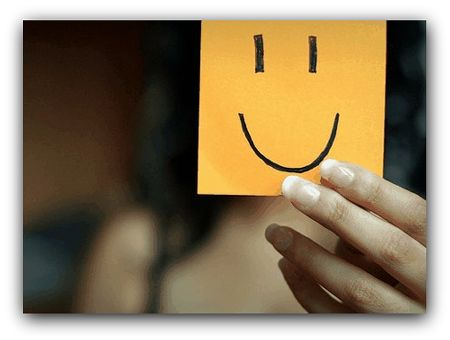 Joy in life. While Marx was speaking of industry, the same is true of life and, yes, joy. Moments are the elements of what one will find profitable in life – learning, experiences, connections, and joy. That said. I read somewhere that pleasure is always derived from something outside you, whereas joy arises from within (extrinsic versus intrinsic). Therefore, in seeking a substitute for joy, the mind will seek salvation or fulfillment through some external stimulation. Therein lies the root of people seeking to define themselves through disasters. It is a warped way to find pleasure, and it certainly does not make joy. Here is the good news. We can save them if you understand the joy and pleasure equation and its relationship with time and space.


