
“… find ways to delegate authority, get information directly from the front lines, and make decisions based on a real-time understanding of what’s happening on the ground. Instead of the old approach of “making a plan and sticking to it,” which led to centralized strategic planning around fixed time horizons, we believe in “setting a direction and testing to it,” treating the whole organization as a team that is experimenting its way to success.”
Stanford
====
- ** author’s note: written in 2018ish this is the draft of chapter 10 of my unpublished book “the conceptual age organization.” this is the companion, technology explanation, piece to “the organizational brain.”
I have always believed digital transformation was an utter waste of time if you didn’t embrace distributed decision-making. I also believe distributed decision-making is an utter waste of time if you didn’t place institutional knowledge at the fingertips of decisionmakers. I also believe placing institutional knowledge at the fingertips of a decisionmaker is an utter waste of time if you didn’t increase learning of the value of complexity (which is actually the axis mundi of conceptual thinking).
Yes. An emergent organization demands effective Autonomy, or distributed decision making, leveraged by institutional memory, augmented by knowledge and navigating complexity.
I have always believed decentralized decision making, or some version of autonomy, increased organizational efficacy – conceptually. I have always believed decentralized decision-making, or some version of autonomy, was mostly a waste of time & effort, in reality, because:
(a) most business models are not conducive to enabling the freedom necessary for autonomy (most business models are simply well constructed cages) and
(b) most leaders do not believe in people enough to actually permit the degrees of distributed decision-making which would release organizational productivity caught in the cages of existing business models.
Regardless. I tend to believe everyone in business understands that the traditional structural organization is changing. And it is doing so painfully and expensively <at a cost>. The change is most typically associated with the transformation associated with infrastructure and technology.
Second. This organizational structural change is tied to the wrong thing. Currently it is being tied to changes as dictated by technology and it SHOULD be tied to thinking construct. The good news is that, regardless of the reason, … the change will be a long arduous shift in the business world as part of a long transition in how business thinks about itself and the best model for conducting a successful business. The bad news is that the businesses that do not adapt are unlikely to survive in the longer term.
This comes down to one basic thought as I discuss the new business model for businesses – however great the costs of this construct change the costs of not changing is much higher.
Anyway. Today’s more rigid ‘construction model’, most typically embodied in a hierarchy, is already outdated. And even by ‘updating’ thru accommodating technology what is being built is more a Frankenstein <let’s insert new thinking & new technology within existing company model constructed to enable a different way of thinking/doing> rather than a concept built from scratch <and having a plan of how we ‘get from here to there’>. The future deconstruction model, let’s say it’s a hybrid of a ‘controlled autonomy’ model, is being built in ‘fits & starts’ in today’s business world.
To be clear.
In my eyes a Conceptual Age Organization incorporates both autonomy & control, therefore, is not a flat organization.
Autonomy in any organization is a combination of control <as in guidelines, principles and systemic behavior> and trust <in that people are intrinsically interested in making a contribution and learning>. This more agile/adaptable organization essentially believes, and trusts, employees want to do well and to do good things therefore incorporating a strong value/integrity base into the everyday behavioral attitude.
By the way, this freaks out an older management generation <who tend to believe everyone is out for themselves and throughout their business lives have fostered a ‘kill or be killed’ mentality>. But the smarter more adaptable management have used this ‘ethical core’ philosophy as a way to move from input-driven work models to structures which focus more on evaluating outcomes and acting upon outcomes.
This reflects a shift in an organization culture driven by systemic behavior driven values and guiding principles. Inevitably this permits more autonomy, better strategic tactics and more fluid responses to customer input without compromising the culture of the business <actually the culture, itself, is emergent from the behavior>. The organization becomes more free thinking, adaptable <constantly shifting resources toward opportunities and away from non-opportunities>, emergent, diverse & interpretive based where the organizational actions rhythm is created by external stimuli — not internally. I will note the traditional Business Model is all about the system. All about rigid systems with space built within for ‘innovation and flexibility.’ In actuality in today’s world the systems cramp and are confined <or confining>. The traditional business model dictates the organizational rhythm and hopes it can match the behavior patterns of the outside world.
In effect the traditional business model was developed with the intent for ‘predictability’ with the overall approach intended to stabilize demand and make it more predictable. Internally it focused on ensuring managers at all levels had enough information to manage their part of the business.
Most companies still do this <albeit they argue they have ‘empowered the customer face units’>.
What makes the traditional business model even worse for agility & adaptability to meet emergent opportunities is that “the Center” maintains the setting and control of budgets and ultimately measures performance against this. If the market, and the world, were stable and reasonably predictable this could <notice I say ‘could’ > work but with unstable and often shifting markets <increasing & decreasing quickly> this model is not only inefficient, it is ineffective.
On the other hand. The Conceptual Age Organization business Model is all about the people and utilizing their minds and reactive attitude <regardless of their particular skills> which makes it naturally adaptive and built more on “I see the information and respond to it.”
The new business model should be constructed with the people and necessary thinking in mind and THEN offer the tools necessary to make that organization successful.
Truly lasting change & organization effect is within people themselves. Effectiveness is emergent. And because it is emergent it is something they not only embody when within the business, but also take with them outside the business (in life, family, community and other jobs). Therefore. To effectively lead people, you actually need to view people beyond the limits of the organizational boundaries. This may sound odd, even inefficient. It’s not. It doesn’t ignore the job that existing responsibilities demand, but it also enables individual potential to cross and bridge normal divides & barriers. Or, as Peter Drucker said, ‘business is of the community and the community is of the business.” And that is where true benefits reside. We far too often discuss ‘getting out of your comfort zone’ when instead we should suggest there is no zone or even if there is you should just push out on the limits and boundaries and give people the freedom to grow (and the business will grow). When a person is engaged as part of who & what they are they have the ability to engage to their fullest potential.
Believing this demands we view a business in a non traditional way – you don’t ‘push down’ beliefs, behavior, responsibilities, etc. because, honestly, any time anything is ‘pushed down’ the world shudders to a halt as the people who are actually doing the work take the round peg senior leadership has created and try to figure out how to put it in the square hole of reality. In order to do so, most times, instead of convincing leadership they actually need a square peg, the teams design a mish mash version of a round peg that will fit into the square hole.
“In our consumer culture, we are encouraged to assume roles that aren’t truly authentic to who we are. In a way, this culture is its own kind of simulation, one that requires us to make more and more purchases to maintain the integrity of the illusion.”
Stowe Boyd
To be clear. I am not suggesting a ‘bossless’ organization. And while I do believe business has become more complex than in the past, I have always believed maximizing an individual maximizes the business. What was true then is exponentially true as business becomes more complex.
Of course an emergent business demands a new organizational models but at the core of any organizational discussion it really isn’t about models, but rather “how do you think about individuals?”
Because until you answer that question autonomy, empowerment, self management, is all irrelevant. If you do not believe in people, then you do believe in control. Period. Full stop.
If you do believe in people, then you will stop talking about leaders, and what makes great leaders, but instead talk about resource management – how can we get the proper resources into the proper hands at the proper times to maximize each individual and group of individuals.
This expands the business by expanding the individual. Therefore, leadership isn’t about just about vision, or control, but rather managing/optimizing expansion.
Most businesses are too dependent upon systems and process and insufficiently attentive to the possibilities of people themselves, their potential to do beyond their labeled skill and imagination, or are simply ignorant of the consequences of limiting decisions and actions. That said. Distributed decision-making cannot be instituted based simply on faith that people will figure it out or have the ‘instincts’ necessary to make it all happen.
The business, first & foremost, has to provide a clear vision, purpose or intent and agreed upon strategies. All need to be clearly communicated and understand.
- ** note: The purpose cannot only be money. In doing so decision-making gets minimized to its most bases level – efficiency & profit. Profits can be made in a variety of devious and less than ethical ways, therefore, decision making should embrace an intent/purpose which permits some latitude for offering better experiences, more imaginative behavior and opportunities for velocity.
Employees buy into vision and quests, not goals, milestones or incentives. Nothing drives progress, velocity and individual meaning than creativity & imagination well used in the process of ‘doing.’ This imagination is practical (albeit it can also be directed toward innovations) in that it means to construct mental concepts of what exists and what doesn’t combining disparate facts and ideas into new conceptual means (leading to specific decisions and actions). This is about converting situational awareness (of the emergent opportunity & probabilities of a successful concept in the future) converted into strategies & tactics the business can implement.
Which leads me to autonomy (decentralization).
It was Sugata Mitra with his 1999 “hole in the wall” education experiment who solidified my belief that people within an organization, left to their own devices, would actually figure things out; that autonomy was not a myth. It was an easy leap of imagination to see if young children could learn without guidance, so could adults. Autonomy comes down to one simple idea: “to what extent can you act independently of supervision?’
I have been in business long enough to see the multidimensional issues with autonomy:
– problems due to someone having either too little or too much autonomy
– problems with leadership actually trusting employees to have autonomy
Both of these problems often result in serious negative organizational outcomes, i.e., productivity suffers and potential is not maximized.
- ** note: Although autonomy and decentralization may coincide and have similar connotations, they often differ and imply varying organizational outcomes. Generalizing, centralization (or decentralization) is characteristic of organization and autonomy is characteristic of individual decision-making.
Autonomy refers to the extent of decision making authority wielded by a given position, person, or organization.
Centralization concerns the locus of decision-making authority in an organization; the extent to which decision-making is concentrated in a single point or diffused throughout the organization.
A decentralized organization is one in which power is dispersed among many individuals.
Let me shift the autonomy discussion specifically to a Conceptual Age organization. Traditionally autonomy is defined as the degree to which one may make significant decisions without the consent of others. But what if this extended to “degree to which one is dependent upon knowledge/wisdom?”
What if a molecular business has aspects of a collective global brain? One in which the while autonomous it is governed, ruled & guided within a ‘closed loop’ ideology.
Complicated Open-Loop Systems vs. Complex Closed-Loop Systems
The biosphere is a complex self-regulating system. It is also a closed-loop system, meaning that once a component stops serving its function, it gets recycled and reincorporated back into the system. In contrast, the systems humans have created are complicated, open loop systems. They are neither self-organizing nor self-repairing. Complex systems, which come from evolution, are anti-fragile. Complicated systems, designed by humans, are fragile. Complicated open-loop systems are the second generator function of existential risks.
Open loops in a complicated system, such as modern industry, create depletion and accumulation. This means that resources are depleted on one end of the chain and waste is accumulated on the other end. A natural complex system, on the contrary, reabsorbs and processes everything, which means there is no depletion or waste in the long run. This makes natural systems anti-fragile. By interfering with natural complicated system, we affect the biosphere so much that it begins to lose its anti-fragility.
Lastly, while I am not a business gamification fan, I would suggest to maximize autonomy a business may need to tap into “good gamification.” What I mean by that is autonomy, to be maximized, almost requires real time feedback/recognition rather than annual performances and an algorithmic based gamification system could offer real time nudges.
============
“And now that you don’t have to be perfect, you can be good.”
John Steinbeck
===========
If one uses their imagination enough, you could see how algorithms could provide nudges based on organizational strategy. That increases in importance because, assuming strategy as being shorthand for what the organization aims to achieve, autonomy (or levels of it) becomes increasingly important to meeting the needs of The Conceptual Age in implementing different strategies.
Autonomy, to be effective in a Conceptual Age organization, is dependent upon shared resources of institutional knowledge and collective intelligence knowledge. This has multiple dimensions:
– Institutional
– Contextual
– Skills (these can be direct & indirect)
– Personal passions (business has a tendency to forget people do things outside the office which require skills)
I believe algorithms and technology play a significant role in making this happen. It is almost like a Conceptual Age organization should seek to become a Human Nanofactory (Walsh, Dictionary of Dangerous Ideas, p. 265).
- ** note: automation and technology play a significant role in knowledge distribution because they can actually contribute to a different type of standardization – progressive standardization. Progressive standardization is most found in Machine Learning which naturally adapts automation aspects to fine tune efficacy (and can even be directed with software updates).
I would note that maximizing knowledge distribution would actually maximize individual meaning as it is possibly the penultimate inclusion, versus exclusion, organizational strategy.
Regardless. Effective Autonomy almost demands some objectivity in conceptual thinking and decision making.
Objectivity is often dependent upon a variety of things: ability to avoid simplistic looking solutions, attitude toward risk, curiosity (and the right type of directed curiosity), attitude toward what is possible versus impossibleand, of course, the ability to force your way through personal bias and the ability to view things from multiple views (conceptually & abstractly).
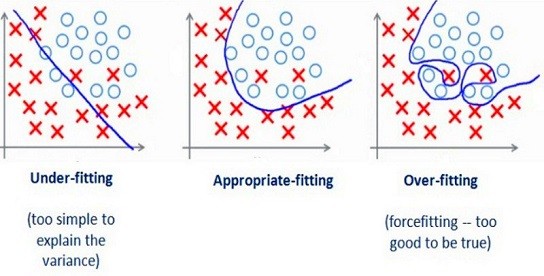
That said. I would suggest true objectivity has to be a strategy. In fact. It must to address possibly the greatest enemy of objectivity: over fitting. While overfitting is a data analysis term, its also a human bias. I would also suggest overfitting is the greatest enemy of conceptual thinking (which would then make it the greatest enemy of a Conceptual Age organization).
In computer science, the question of how to create benchmarks that allow a program to learn from past experience is at the heart of machine learning. Machine learning can arc toward increased performance or poor performance as it treads the delicate tight-rope between underfitting and overfitting.
Simplistically, this is exactly the situation the decisionmakers of the Conceptual Age organization is faced with. In fact I would argue because of the importance of conceptual thinking, which is inherently abstract, the battle between underfitting, appropriate fitting and over fitting will define who wins the future war in the future of work.
Overfitting is one of the banes of business – it is a reflection of the ongoing battle between certainty & uncertainty. it is actually the response to people who do not understand probabilities and fear explaining uncertainty, randomness and the sometimes quirkiness of anything to do with people.
The world is complex. Humans are complex. Life is complex. Work is complex. Business is complex. We deal with inherent complexity every single day. It’s naïve to think we can solve complexity nor is it smart to think we should solve complexity. Complexity is expansive and actually a force for good.
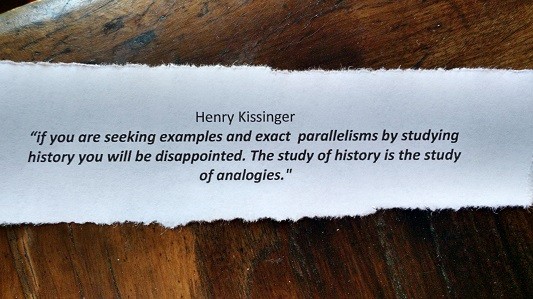
Overfitting, simplistically, is the human desire to find parallelism rather than analogies.
- ** note: obviously, if an organization is going to be dependent upon a foundation network of algorithms and technology the Algorithms & technology need to be discussed. This means ethics and accuracy. We need to begin somewhere and as I stated in 2010 when discussing a global education initiative I designed, the UN Universal Human Rights is as good a place to begin as any. For some great thinking on technology & ethics I highly recommend both The Ethics Centre “Ethical by Design: Principles for Good Technology” 45 page manifesto as well as listen to “Why we need more Human Algorithms” a podcast with Flynn Coleman and Mike Walsh.
The pathway out of the underfit/overfit trap is something I call the pursuit of ‘optimal certainty.’ Concepts, and conceptual thinking, will demand navigating reams of data, simplistic dashboards, an innate desire for certainty and a business world relentlessly unforgiving to ‘not meeting established goals’ (which are inherently flawed because they are based on probabilities and a context which, most likely, no longer exists).
‘Optimization matters only when it matters. When it matters, it matters a lot, but until you know that it matters, don’t waste a lot of time doing it. Even if you know it matters, you need to know where it matters. Without performance data, you won’t know what to optimize, and you’ll probably optimize the wrong thing.’
Joseph M. Newcomer
I would argue our capacity, potential, is defined by maximizing optimal certainty.
Too much uncertainty and clarity is elusive (and clarity is the energy for progress). Too much certainty and clarity actually blinds you (it ceases to be true clarity and more simplistic focus).
- ** note: Algorithms and statistical analysis will be the foundation of all Conceptual Age organizations. Period. All business models will have this framework interwoven among the people and the people need to become inculcated with the strengths, and weaknesses, of data, algorithms and statistical analysis. “Premature optimization is the root of all evil.” Here are two excellent starting points:
Donald Ervin Knuth, The Art of Computer Programming, Volume 1: Fundamental Algorithms
Paradoxes of probability and other statistical strangeness
“Can you always optimize?” Yes and no. Optimization is not always a sacrifice of one thing for another but more often than not we make it so. That said. Do not do clever optimizations that have no meaning or actually LOSE meaning in compromise. Meaning can be lost in 2 main ways:
– Complication: in the pursuit of ‘balance’ a decision/solution is arrived at that is hard to develop, difficult to debug, and absolutely impossible to maintain.
– Simplification: in the pursuit of everything you arrive at nothing. Now, to be clear, that ‘nothing’ can look good, look smart and even look right, but more often than not in the pursuit of ‘optimal’ you squeeze out any of the value that could have been achieved.
In either case, optimization is meaningless.
It was William Ogburn who said “we should admit into our thinking the idea of approximations, that is, there are varying degrees of accuracy and inaccuracy of estimate.” This flies in the face of what most business people seek – tighter certainty in the future. The entire concept that having an approximate idea of what lies ahead is better than having none is an anathema to most business people. They see an approximation as of equal value to knowing nothing. “That doesn’t do me any good” would be the conference room utterance while viewing such a thought. Which leads me to Alvin Toffler from his 1965 Horizon article “The Future as a Way of Life”.
“Perhaps we need special courses in ‘how to predict.’”
“How many of us, even among the educated public, understand the meaning of a random sample, or of probability, or of prediction by correlation? This does not mean all of us need to be statisticians or logicians or mathematicians. But the principles of s scientific prediction can and should be grasped by every youngster who graduates from high school, for these are not merely the tools of scientific research, they are powerful instruments for dealing rationally with the problems of everyday existence.”
- ** note: on a prescient note Toffler also warned in the 1965 piece that he said “it would, of course, be foolish to oversell the ability of science, hard or soft, to foretell the future. But the danger today is not that we will overestimate this ability, but that we will underutilize it.”
Sound thinking is not in the purview of certainty, but rather either probabilities or optimal certainty. This is not to suggest that the future can actually be predicted as a single static future (it cannot), but rather to offer an overarching territory in which business quests can explore. Preciseness does not matter. In fact, preciseness is the enemy of adaptiveness (or makes one Fragile in Taleb terms).
Which leads me to complexity and “managing complexity” (and some issues associated with complexity of business)
I believe many of us have known business has been imperfect for quite some time – objectives misguided (or flawed), objective setting misguided (or flawed), hierarchies & command control indicative of a factory mindset (and flawed), long term was subjugated to short term narratives and specialization has been valued over generalism. Many of the answers to these concerns have been right in front of us for quite some time, but we have continued to ignore them in the pursuit of simplistic suggestions rather than complex solutions a complex business world demands. I believe a portion of this resides in our lack of desire to face business as complex, complexity as expansive, and an inability to embrace a belief the future cannot be handled in a linear “do this well before doing this” truth.
- context: accelerated world
Solving business challenges can be complicated, but business itself is complex (& always has been). Business people cannot afford to confuse complicated and complex. Now. What technology did is accelerate the complexity. The business atoms were placed into a supercollider. In fact, it accelerated business dynamics beyond the structure of a hierarchy or even centralized “buck stops somewhere” managers. That said. I think we confuse speed and acceleration all the time to the detriment of organizational design and behavior. Organizational design almost seems to inherently have a desire to decelerate to permit some sense of “its okay, you can feel comfortable with the speed of business” where I think we would be better off addressing the larger issue Toffler outlined: overstimulation. Acceleration tests our attention, cognitive skills and ability to discern what is important and what is not – which is actually a ‘speed’ versus velocity discussion. The article, by suggesting the basic business world is the same, ignores that, in a grander context, it is not. In fact, the article is incredibly misguided because it would appear to encourage insular cocooning rather than suggesting the challenge is to fully engage & manage overstimulation. I am not suggesting acceleration & overstimulation is not an issue, but I will suggest it is a reality and hierarchies (centralizing overstimulation) is not the way to increase the likelihood of business success. If I were to choose one aspect, I wish organizational psychology would address, this is it.
Which leads me to connectedness.
- everything is connected with everything
When I read simplistic tripe like “The basic problem of management and business – how to assemble, organise and motivate groups of people and resources to produce goods and services that consumers want” I can understand how hierarchies have been so resilient to a better way of doing things.
In the past it was arranging lego blocks, now it is arranging molecules. Toffler discussed this in a variety of ways, but the most interesting was “porous organizations” in which teams assembled, and reassembled, in order to meet specific challenges. He outlined this in 1970. Nowhere in that concept did he discuss no bosses, but he did suggest in 1990 (Powershift) that the biggest challenge to this idea would be power. The new business normal faces two dynamics: power & interconnectedness. Needless to say, they are connected.
Which leads me to untidiness.
- discomfort with untidiness
Businesses inherently love tidiness and hate untidiness. They associate predictability & certainty with being tidy and inefficiency & failures/mistakes with untidiness. Unfortunately, for business, mediocrity (or even slippery slope to irrelevance) resides in tidiness and spectacular success resides in untidiness.
While we like to think of organizations as a ship sailing into a tumultuous sea. It is actually a fleet of smaller ships being pushed & shoved by tides and waves through storm & calm all trying to go in one direction together <without crashing into each other>. Each smaller ship has a captain and a crew <often skilled in managing that particular ship if needed>.
Far too many people associate ‘building a dynamic organization’ or even ‘motivating employees’ by inevitably suggesting one big ship making progress in some direction (although they give a head nod to a matrix organization). They seek tidiness. They are wrong.
I say all that because you invariably need to grow your business unevenly. Yup. Sorry. A business isn’t, probably shouldn’t be and most likely cannot be <and be successful> ‘even.’ Or smooth. Or without any ragged edges. It needs to be grown unevenly <which is actually a natural growth rather than some manufactured growth>.
“Sureness will always elude you. The detective will always circle around what he wants, never seeing it whole. We do not go on despite this. We go on because of it.”
Claire DeWitt
Which leads me to freedom.
Business, for decades & thru hierarchy, has always been built around selective freedoms – maybe ‘controlled freedom.’ Business people, in general, are much more comfortable building stop signs than they are highways. Toffler spent almost an entire book outlining how technology will create a freedom ‘shock’ (Future Shock) and an entire book on the shock to the power structures (Powershift).
I am not suggesting 100% freedom from day one because most people like having some fences (that’s why they often get built). And many people would be lost with unfettered freedom, well, they would be lost in the beginning because the majority of people have endured a life where they have existed within tight constructs, cages in other words, so freedom must be given in ways in which the individual prospers. I want to be clear. This doesn’t suggest people cannot grow into their freedom, but rather most people used to a centralized hierarchy will be most successful in accepting freedom in phases. Ok. Maybe not phases, but rather stages of self learning (what am I capable of, what do I like, what am I comfortable with, what scare me, when & how I should seek some assistance). We cannot ignore that many people, even those who want this idea, will have to feel their way thru the maze of freedom.
Also. Please note this is about cognitive load, not ability. Reducing cognitive load insures better decision-making. This actually means the Paradox of Choice is also the Paradox of Decision making. BUT, it’s not that simple because choice overload isn’t a consistent effect across all people and choice reduction alone does not ensure an increase in decision effectiveness. A 2015 meta-analysis of 99 studies isolated the circumstances in which reducing choices to customers are most likely to increase sales. What they identified is four factors:
– Choice set complexity
– Decision task difficulty
– Preference uncertainty
– Decision goal
What they saw across studies is that when the above factors are mitigated, the tolerance for choice often increases. Essentially, reducing complexity is more important than simply reducing choice. I would argue this is exactly the same for decision making and within a Conceptual Organization this should be an objective in algorithm development & application.
Unfettered freedom CAN lead to chaos, so, we come up with a number of behavioral & motivational tricks to attach to versions & steps to implement aspects of distributed leadership mostly because we ignore what we know about individual behavior and we have a healthy skepticism toward managers & management in general.
Gamification, carrots & sticks, incentives, milestones are all derivatives of hierarchy thinking trying to adapt to a relentlessly uncertain world. They are attempts to build in some certainty. Yet. Behaviorally we know the most powerful motivation has nothing to do with ‘defeating’ a system/objective/goal, but rather it’s about ‘belief.’ Defeating is someone wins, someone loses. Belief is like hope. It draws people toward it.
That said. It’s a twofold belief challenge. Business owners, managers as such, need to believe in people. They need to believe if given the opportunity to make choices, do the right things, the arc of people behavior (driven by intentions) will bend toward productivity & profitability. Note. This means business community needs to embrace a lack of output smoothness (a perception & reality challenge in & of itself).
Look.
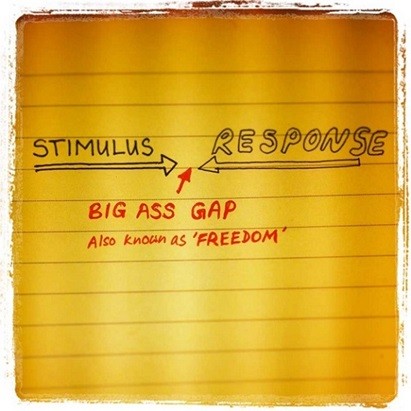
Autonomy is a paradox. Giving autonomy actually decreases the vulnerability of a business, yet, giving autonomy makes many in leadership feel like the business has become more vulnerable. This is like giving freedom and, yet, building cages simultaneously. I imagine I should suggest at the end of this particular section that any business needs some ‘loosely held cages’ in which institutional knowledge, some enabling constraints and actionable principles reside all created with the intent to reduce cognitive load so people, individuals and teams, can optimize conceptual thinking and decision making.
“Society, community, family are all conserving institutions. They try to maintain stability, and to prevent, or at least slow down change. But organizations are organized with the intent to destabilize. Because its function is to put knowledge to work – on tools, processes and products; on work; on knowledge itself – it must be organized for constant change.”
Peter Drucker


 A 56 percent majority of Trump voters say that if a national media outlet reported that Trump said something untrue, they would be more inclined to believe him than the news outlet.

 The Trump ‘empire’ spans the globe. He is a ‘globalist.’ That said. Trump’s view of globalization is not a normal transnational business person’s thinking about globalization. He thinks about it, as he does about everything, in a very transactional way. The global economy may be interconnected in a variety of ways between countries, but he never looks at it as a complex weave like a web of possibilities but instead as a simplistic series of small linear transactions which get a assessed in a win/lose way. It’s simplistic, it’s flawed, and dangerous – at least if you were worried about the future prosperity of the United States.
 To be clear. None of what I’ve shared isn’t to suggest the existing system is perfect, but destruction of the system, and USA central role, is clearly not to the benefit of America’s future.
 ==
== Prior to the invention of clocks time was mostly driven by light (sundials) and tasks (harvest). The work took as long as it took and what could be done was done when the sun was shining. We slept when it was dark and, uhm, when we were tired. Yeah. Our attitudes toward sleep is cultural. Naps, siestas, and breaks in the hottest part of days, are part of society unless, of course, if you are American, the land of the people who are always exhausted and unwilling to waste time napping. I say all that to suggest time and culture have a relationship. That said. What I do know is that uniform timekeeping is inextricably tied to industrialization. I’m not suggesting that we haven’t always sought better ways to assess time or even to make better clocks and time keepers, what I am suggesting is that timekeeping has become the default for society’s view of time. And therein lies an issue we have truly failed to grapple with as a society – and individually. By looking at clocks and the time keepers we’ve forgot to look at time itself. We have sought to try to discipline time using it to discipline us (humans). The problem is the time is elastic. Yeah. Time seems short in good time and bad times seem to last forever. Tahat happens despite the fact we clearly know that time never really slows down, it is more in how we remember events that make us believe that time has either sped up or slowed down. Uhm. This also suggests the brain itself is elastic. Or maybe I should say that the brain has some emergent characteristics in that our senses adapt to context.



 Which leads me to the role of technology.
 It is when a business can align all aspects that not only will they maximize the potential of a person, which the business benefits, but it will also maximize personal meaning, therefore, maximizing the organizational brain.
 That thought possibly gains importance because in today’s world, whether you like it or not, people are expected to cope with increasing complexity, change and diversity. Simplistically this means in a complexity world people are asked to tackle a much greater diversity of problems/opportunities. All the while we seek to maintain some of the efficiencies of life (or the business) – the rituals, replicable events, etc. – but to get ahead, or maintain some progress, knowledge and information has to be absorbed to meet the demands of future problems/opportunities. Said differently, complexity demands structure AND flexibility. And while that sounds almost impossible, if not uncomfortable, I will remind you of Atkinson “
 From a meta perspective, one could argue that our ideal is incompatible with industrial progress and industrialization. From a mesa perspective, it could simply be the constant friction between the ideal and reality. So, let’s stick with the latter for a moment. There is a reality of progress and that is, well, its relentless energy constantly grinds against the present reality. That constant grinding is a reflection of the tension of people relentlessly holding on to ‘some vision of the ideal’ despite all the signs and warnings reality continuously gives us. This oddly seems to feed a sense of powerlessness. As reality becomes more and more obvious the freefall from the heights of the ideal to the material reality is horrifying. And yet day in and day out we look around at a rude, restless, world and continuously try and replace it with polite order and machines hoping to force reality to reflect more our ideal. Unfortunately, our world is an intricate semi-organized urban/rural/industrial/agricultural society of which the machinery of its collective existence encourages us to have an image of humankind in the grip of uncontrollable forces. Once again, we are faced with another conflict of reality. Industrialization, once associated with movement and noise, has entered another phase of industrialization, technology, but one in which eliminates all evidence of any of the frenzied chaotic movement and clamor that we have always associated with industrialization. Once again the silence is horrifying and yet wherever there is noise we begin believing there must be a problem – quite the paradox. Maybe worse is that this silent machine simultaneously works against our dreams and simultaneously enables our dreams which creates even more tension/conflict. I’d suggest this is a battle between reality and imagination, progress and the ideal. And throughout, humans being generally an optimistic bunch, we hold on to the simple-minded notion that everything can be right again and can be made right again. We work harder and harder to fix things that we just can’t put a finger on. As we work, we grab onto a temporary feeling of relief that maybe we were on the path to some solution and the hope of a lasting possibility. The ideal can never be let go no matter how harsh reality suggests we should let go. It is almost like The Great Gatsby when Nick says “Gatsby did not know that it was already behind him, somewhere back in that vast obscurity beyond the city, where the dark fields of the Republic rolled on under the night.” And maybe that is where living in the now runs into the most issues. The imagined versus reality. Or continuous efforts to banish facts in order to maintain faith in the ideal. It is the relentless tug of the possibility which simply makes optimizing the present so difficult.
 Because these things dominate the definition of our space, we will typically gravitate towards who we know and what we know and, well, staying in place. To be clear, part and pieces of that are good, but we need to acknowledge the need for some boundaries in social cohesion. That being said even the boundaries which we erect for the safety of who and what we are should be permeable boundaries. What I mean by that is the boundaries have an infinite amount of doors in and out. And this is where the present comes crashing into the conversation. For if you have ideals and yet you are trying to maximize the present who owns the right of the space or the time or even the present, who even owns the doors? For it is within the space where the ideal becomes inherently social and not individualistic. And this is where “better for having you there” resides, for ‘you’ is not an individual but rather a collective. It is this space in which maximizing the present and reaching for the ideal is always about all about keeping a balance between what is built and what is grown, the architect and the gardener. Negotiation, compromise, genuine empathy, in an embrace of other people and their ideas all of which creates a daily testing of boundaries among people. Sure, there will always be tension between private benefit and common good, but social cohesion exists because of a meaningful and moral intent for progress and it is actually progress, not inertia, which promotes a sustainable social identity. Some of this may sound silly in the crazy hectic nonstop 24/7 world that we live in. But I would be remiss if I didn’t point out that loneliness is not just the absence of meaning, but just as much can be found in the absence of company. What I mean by this is that you can feel alone on an empty street just as you can feel alone on a crowded street with busy people going here and there. Yeah. With no social connection we find ourselves in a bubble of isolation even when surrounded by people. To be clear, connection is simply the first step toward community and collective good, but without it there is no community or collective good. Anway. It is at this point it’s quite possible that someone seeks meaning by trying to maximize the present – as an individual. That is simply a fool’s errand and it does not really offer a true path to “making that place better for you having been there.” Once again, without connection one can never truly maximize a situation nor do they improve their chances of moving any closer to the ideal nor do they really have an opportunity to make where they are better for being there.

 Just like some people like walking around with coins in their pocket so they can reach in and make them jingle, I like walking around with words in my pocket. This matters because unless you can draw pictures out of thin air, you will be stuck using words to explain something, get what you want or get someone to ‘see’ something. Take a moment and think about what I just said because that is the rationale for treating words with respect and to value the beauty of a well-placed word. I am not a godly man, but if you ever doubt that a higher being exists wouldn’t words be proof of some existence?
 One would think unity would be a word well used in almost any environment, but context warps everything.

 We honor creativity and imagination culturally mostly because creativity is as much social as an individual effort. What I mean by that is any true adventure of creativity and imagination connects with other people at some point; if not multiple points. This is kind of the part of diversity I wish we spoke more often about. When people of different backgrounds come together, new ideas arise from their conversations. The truth is that progress, and new thinking, tend to be crafted incrementally from the fragments of different viewpoints. Once again, creativity is a social affair. I say that because that suggests that creative genius lies in the foundations of social itself. So, uhm, adventures of the imagination are adventures of society. And just as I stated earlier, the imagination of a couch potato is different than the imagination of an adventurer. And, once again, the main difference is that an adventurer ventures out, amidst others and their ideas and their adventures, and, well, imaginations get honed into realities. And those realities become stuff of myths, stories, and narratives.

 anyway other than in other Life has its rules and requires some responsibilities and the rules kind of offer some boundaries for accountability.
 Only to find it isn’t really a destination but rather simply a rest stop on the highway. In fact many of those destinations, which are desired and have been well defined outlined and tasked, turn out to be places we reach and as you take a look around with a satisfied sigh of completion you end up saying: ‘shit. I’m lost.’
 And yet we constantly try to make it linear only to be constantly disappointed when we end up back where we began.